
Rock RMS Staff Mobile App for On-the-Go Ministry Work
This Project At a Glance
I helped North Point Ministries design and launch a native staff mobile app built on Rock RMS that brought together spiritual formation, internal communication, people intelligence, and AI-powered workflows into a single, mobile-first experience.
Client: North Point Ministries (Digital Services Team)
Platforms: Rock RMS, native iOS & Android
Scope: Product strategy, UX design, data modeling, AI integration, workflow design, rollout
Audience: 600+ staff across nine Atlanta-area campuses
The Challenge
North Point staff relied exclusively on desktop-first ChMS UI that stifled practical workflows, limited access to people data, and failed to support the reality of on-the-go, relational ministry work.
The Outcome
The staff mobile app gave our staff teams a new, trusted, mobile-first place to engage Scripture, stay connected to organizational life, access people insights, and take action on ministry opportunities in real time, increasing adoption of Rock RMS and laying a scalable foundation for future mobile and AI-driven capabilities.
About This Project
The Context: A Mobile Strategy Assumption Worth Testing
For years, North Point Ministries assumed its attendee mobile apps were well utilized. Mobile had become part of the expected church technology stack, and we believed it was serving its purpose. That assumption changed when I began closely reviewing analytics from our existing Subsplash-based apps.
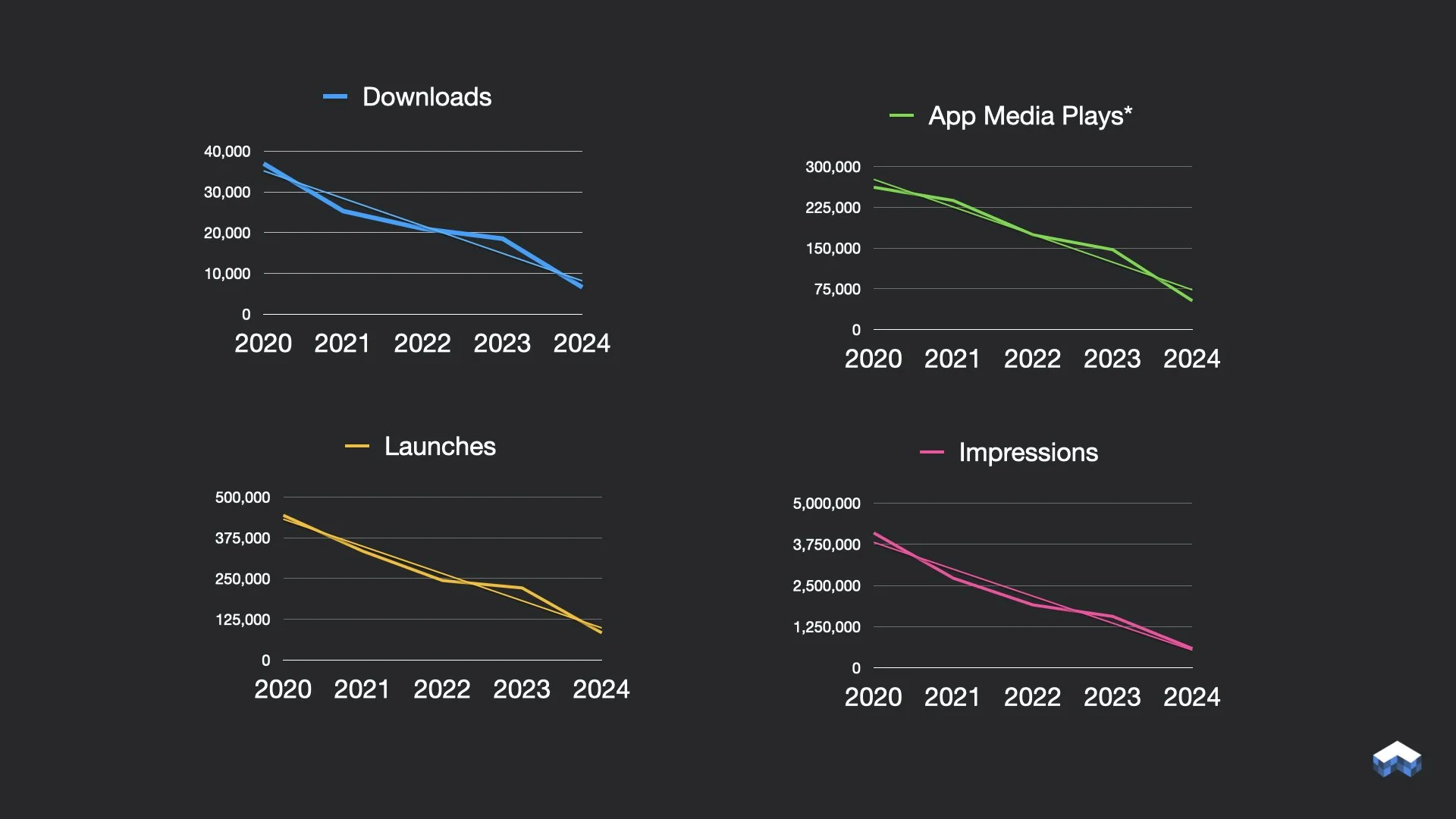
A clear downward trend across key app metrics gave us the clarity we needed to challenge assumptions and rethink our mobile strategy with fresh eyes.
Across every meaningful metric, downloads, launches, media plays, and impressions, engagement had been in steady decline since 2020. The data made it clear that our mobile strategy was not keeping pace with how people actually wanted to engage with the church outside of Sunday mornings.
We knew mobile still mattered. The question was no longer whether we needed a mobile strategy, but what kind of strategy would actually work.
Reframing the Problem: Before Choosing a Platform, Run an Experiment
Rather than committing immediately to a large, irreversible platform decision, I intentionally encouraged our team to approach this work as an experiment. A key influence on my thinking was Jim Collins’ concept in Great by Choice of firing bullets before cannonballs, that is, running low-risk, high-learning experiments before making a big, resource-intensive bet.
The question wasn’t simply which mobile platform to choose, but how we could make that decision with confidence. Instead of starting with a highly visible attendee app that would be used by 40,000 attendees, I proposed building a staff mobile app first. It needed to be genuinely useful for our team while also serving as a practical way to pressure-test a platform’s real capabilities, constraints, and long-term maintainability.
By framing the project as a “bullet,” we gave ourselves permission to learn quickly and honestly. Building in Rock Mobile allowed us to evaluate data flow, customization limits, development effort, vendor responsiveness, and release processes in a real-world context without risking the broader attendee experience. The goal was not to prove that a platform could work, but to discover whether it should work for us over time.
This reframing shifted conversations with executive leadership from “Which platform should we pick?” to “What do we need to learn before we commit?” That shift made the project easier to approve, easier to evaluate, and far more valuable than a traditional proof-of-concept or premature platform rollout.
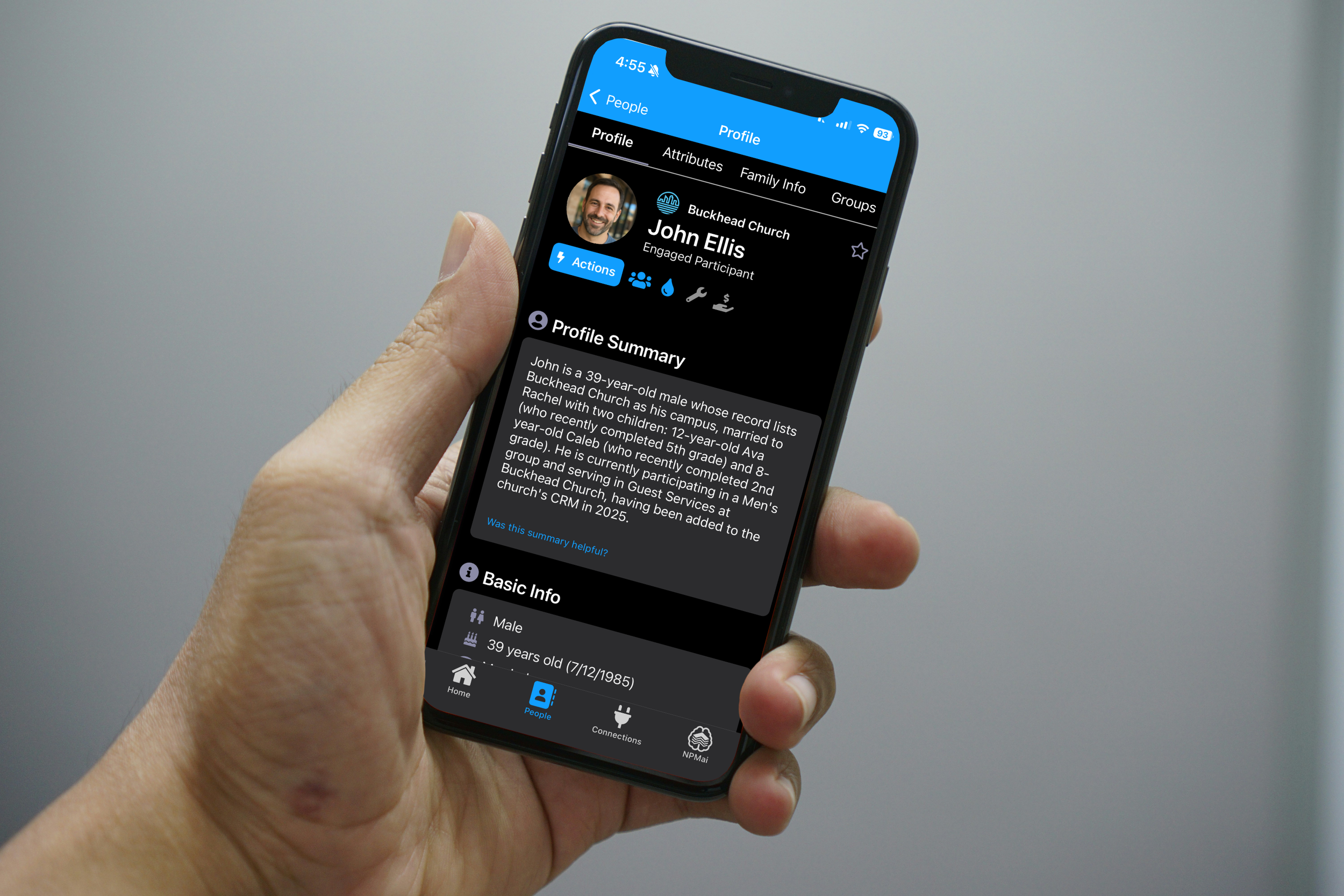
I did a full redesign of Rock’s default profile experience, prioritizing fast access to critical attendee information and introducing an AI-powered profile summary that brings family and engagement context into a single, mobile-friendly view.
Designing a Daily Companion for Staff
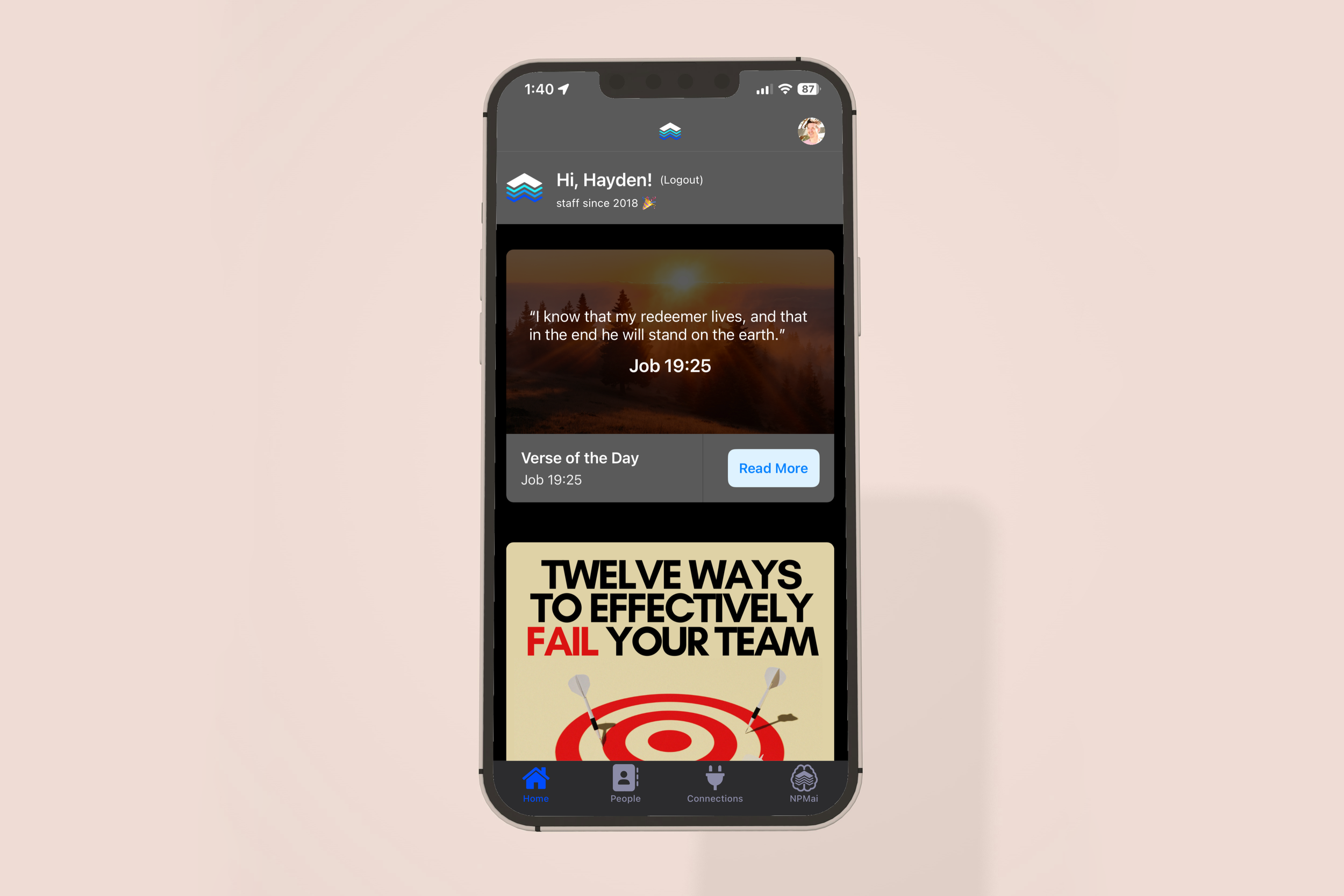
The app was intentionally designed to support the full rhythm of staff life. The home page experience centered on daily engagement, featuring a verse of the day inspired by research from the Center for Bible Engagement, with links to read Scripture in context. We paired that with staff culture content and campus-specific announcements so the app felt relevant and fresh every time it was opened.
Operationally, the app needed to be genuinely useful in the flow of ministry work. We designed a people search experience that pulled directly from Rock RMS, surfacing essential profile information, family context, group involvement, and engagement history in a mobile-friendly way.
We also intentionally brought an AI-generated profile summary feature into the mobile app that had already been developed for the Rock desktop experience. Rather than limiting that new capability to desktop workflows, we extended it to mobile so staff could quickly understand a person’s engagement and family context at a glance while on the go, without having to navigate deep into individual profiles.
Staff could also take action directly from the app, initiating background checks, reporting data errors, requesting profile updates, and managing relational follow-ups through a custom mobile interface built on Rock’s Kanban-style “Rock Connections” feature. We later embedded NPM AI, a RAG-based internal knowledge assistant that allowed staff to ask plain-language organizational questions and get immediate, trustworthy, org-specific answers.
The Reality of the Platform
As development progressed, it became clear that Rock Mobile was less mature than expected. Core components required heavy customization to achieve a usable and modern interface. Vendor support was limited, and even launching through Rock’s App Factory process was cumbersome.
We ultimately completed the experiment and built an app we were proud of, but the experience answered the strategic question we set out to test. Rock Mobile was not the right long-term platform for the level of flexibility, iteration, and polish we wanted.
As a result, the app was not launched broadly. That decision was intentional, informed, and ultimately successful.
The Impact
The project gave leadership real, experiential insight into what it takes to build and maintain a modern mobile app at scale. It clarified platform tradeoffs, influenced future vendor conversations, and positioned North Point to make a more confident decision about its mobile ecosystem.
Why It Mattered
This work prevented a costly long-term commitment to the wrong platform and replaced assumptions with lived experience, helping the organization move toward a mobile strategy grounded in data, clarity, and sustainable execution.